+44 1865 259200
Wider Impacts
Analysis of the wider impacts of actions to reduce emissions
Actions to adapt to or mitigate climate change often have wider social, economic and environmental impacts. These impacts can be both positive and negative. For example, tackling energy efficiency by improving insulation can have local benefits through developing job opportunities and supply chains, economic impacts from reduced fuel bills and health benefits through improved living standards.
Wider impacts analysis is increasingly important in policy development. It brings new information to support policy decisions within public and private organisations. In a more holistic approach to policy making, it allows the consideration of other possible impacts of policies beyond the initial intended effect. It also helps stakeholders to avoid seeing climate action as separate from other development priorities; the challenges of climate change are inextricably linked to other global and local economic, social and environmental challenges. The apparent dichotomy between climate action and prosperity is a false one.
Aether has experience in linking the wider impacts of climate actions to other national strategies (e.g. economic, social and environmental) and Sustainable Development Goals. Aether has compiled a wider impacts database, including scoping studies on current and future research and location specific studies. You can read about the development of the database here, and see some interactive outputs here.
Aether’s approach
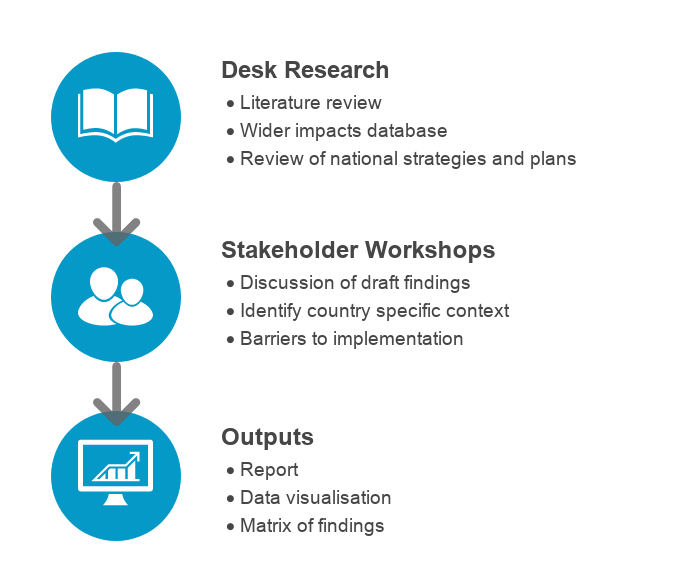
Through our experience built up across multiple wider impacts projects, we have created an efficient and effective approach to analysing co-benefits. We combine desk research with stakeholder engagement to produce useful and engaging outputs.
Wider impacts database
Aether’s wider impacts database is kept up-to-date with scientific literature sources of wider impacts of climate and air pollution policies. We have used it to produce wider impacts analysis for countries including Luxembourg, Jersey, Barbados, St Vincent and the Grenadines and Guyana.
The database contains nearly 1500 sources of wider impacts information including academic papers, technical reports and online articles. This covers 80 different countries and regions including Europe, Africa, Asia and South America and contains evidence for co-benefits in a range of sectors including buildings, industry, energy, transport, forestry, agriculture, land use and waste.

Aether's highlights
Wider impacts of climate action in Luxembourg (Government of Luxembourg, 2021) – This work aimed to increase the understanding of the potential wider impacts of Luxembourg’s actions to tackle climate change as well as barriers to implementing effective climate action with minimal negative wider impacts. The work linked together Luxembourg’s reported climate actions with the ten priorities set out in Luxembourg 2030: 3rd National Plan for Sustainable Development.
An interactive viewer linking climate actions to Sustainable Development Goals (in-house project) – Literature review focussed primarily on evidence from developing countries, covering agriculture, energy, LULUCF, transport, waste, knowledge and awareness raising, and other common climate actions. The results are presented in an online, interactive tool (see links).
Investigation into the wider impacts (positive and negative) of climate mitigation and adaptation actions in Jersey (Jersey Government, 2017) – Wider impacts in the context of economic, social, and wider environmental priorities identified by the public and Jersey government. Initial findings were presented to a range of public and private sector stakeholders at an in-country workshop to identify Jersey specific insights and possible barriers to achieving the expected impacts in Jersey.
Analysis of the potential wider impacts of climate mitigation actions in the built environment and transport sectors in Scotland (Scottish Government, 2016) – The studies provided a comprehensive overview and synthesis of existing and planned research. The transport sector report covered mitigation actions such as active travel, improved public transport and lower carbon vehicles whilst the built environment sector report investigated actions such as reduced energy demand, sustainable buildings and low carbon energy supply. The outcomes were used to inform the Scottish Government’s third Report on Policies and Proposals.
Scoping project on the co-benefits of climate change mitigation (DECC, 2016) – Aether with Alison Smith on a scoping study for DECC (now BEIS) to provide a comprehensive overview and synthesis of existing and planned research on co-benefits and possible adverse side-effects of climate mitigation actions, and to make recommendations for further research. The scoping paper was compiled through a detailed literature review, a call for evidence, a review of existing grant programmes, and a workshop with 20 academic experts.
Links

Testimonial
Don't just take our word for it...
Contact us