+44 1865 259200
Progress to reduce air pollution inequality in London
15 January 2019
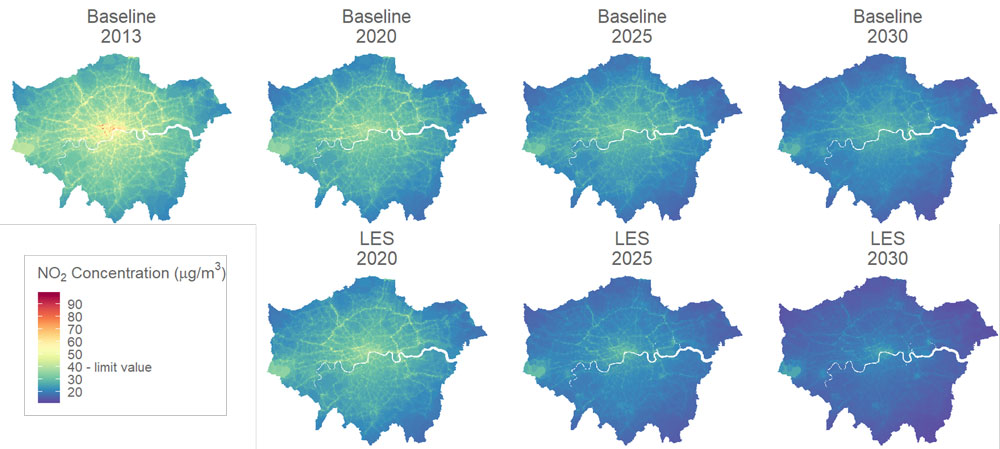
Analysis undertaken by Aether on behalf of the Greater London Authority has shown that policies to reduce air pollution in London will also reduce inequality. The work analysed the impact of the London Environment Strategy (LES) on air pollution exposure across both deprivation levels (as measured by the Index of Multiple Deprivation) and the distribution of different ethnic groups. Impacts on schools, hospitals and care homes were also assessed. The key finding was that while differences remain between exposures in areas of higher and lower deprivation, these are greatly reduced in the future under the “baseline” scenario (which includes the central London Ultra Low Emission Zone) and even more so with the addition of LES policies and measures.
The association between higher air pollution levels and higher deprivation has been established in numerous studies, including Aether’s own work undertaken for the GLA previously. This study shows that, for NO2, the gap between the annual average concentration between high to low deprivation areas reduced by 71 per cent by 2030 – from 7.6 µg/m3 in 2013 to 2.2 µg/m3. However, while exposure to PM2.5 also reduced across all areas, very few locations fell below the 10 µg/m3 annual average WHO Guideline Value.
Katie King, Director of Aether, said: “This builds on earlier analysis undertaken by Aether and shows that the link between deprivation and poor air quality can be substantially reduced through positive action. The very mixed social structure of London complicates this type of analysis but the overall pattern of both improvement and a reduction in inequality can be clearly seen. However, there is clearly more to do if the WHO Guideline Values for particulate matter are to be achieved across the capital.”
News topics
Aether Blog Air Pollution Air Quality Assessments Barriers to Net Zero Capacity Building Carbon Footprint Climate Equality Climate Finance Data Visualisation Emissions Reporting GHG Infrastructure Inventories Local Government Mitigation MRV National Government Net Zero Policy Recruitment Society Stakeholder Engagement Waste Sector Wider Impacts
Testimonial
Don't just take our word for it...
Contact us